
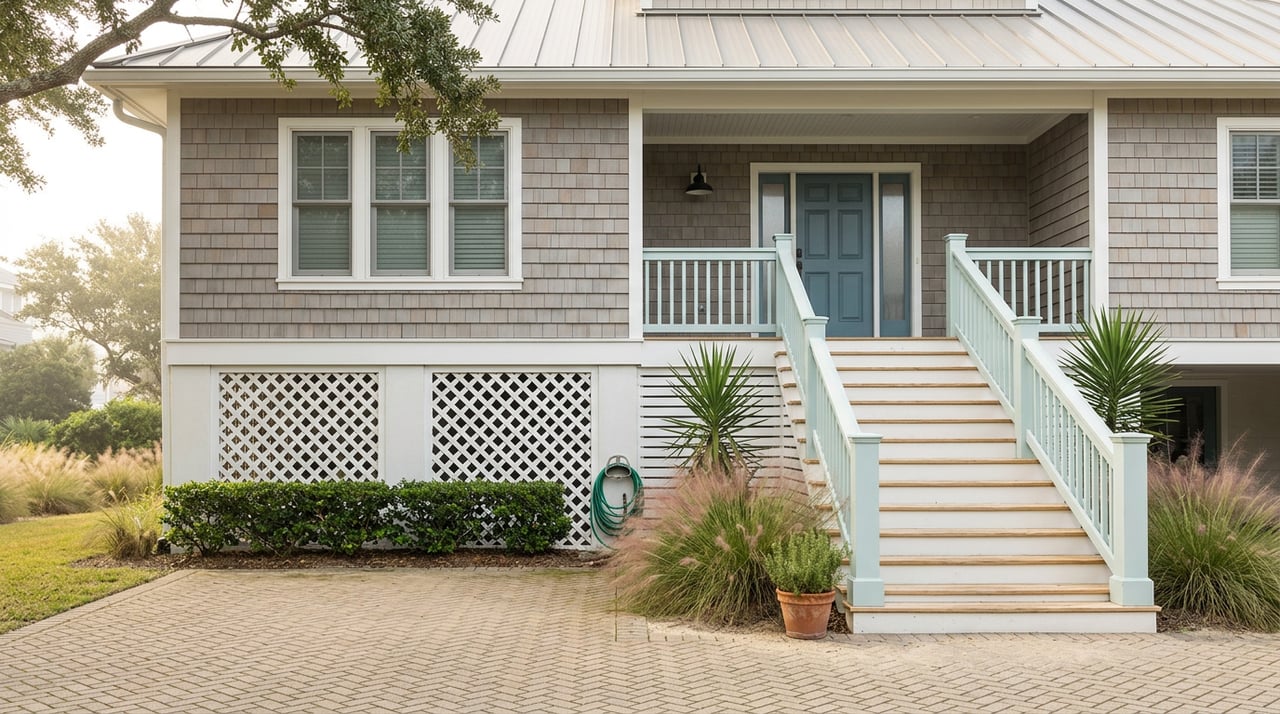
A home in the Currituck Club with paved-road access and NFIP flood coverage sells like any other beach property in America. Drive eleven miles north, park at the same latitude, and the property next to it under the same zip code sells through an entirely different playbook: cash, a portfolio lender, or a private flood policy assembled before closing. Same town name. Same 27927 zip code. Two separate mortgage markets, split by a federal law most buyers have never heard of.
That split is the reason a four-bedroom cottage in Carova can list for under $400,000 while a comparable home just south of the pavement, inside a developed Corolla community, comfortably clears seven figures. The gap looks like a story about sand roads and inconvenience. It is actually a story about a 1982 act of Congress that decided, decades before either buyer was born, which of these two houses would ever qualify for federal flood insurance.
The Line Nobody Draws on a Map
Corolla's paved section runs from Pine Island north through the developed communities: Corolla Light, Whalehead, The Currituck Club, Monteray Shores, and Ocean Sands. Where NC-12 ends, the pavement stops and the beach becomes the road. From there it is roughly eleven miles of sand to Carova proper, passing through Swan Beach, North Swan Beach, and Penny's Hill along the way. Drive time runs 30 to 90 minutes depending on tide stage and sand compaction, and from Norfolk International Airport the door-to-door trip averages three to four hours.
Everything past that line runs on private well and septic. There is no municipal water, no cable television, and USPS does not deliver mail to a Carova address at all. Owners keep a PO box in Corolla or in Knotts Island and rely on UPS, FedEx, or Amazon for direct delivery. A volunteer Fire and Rescue station covers more than 600 homes across the eleven-mile stretch. During the Memorial Day to Labor Day season, Currituck County caps beach parking permits at 300 per week to manage congestion on the sand.
None of that, on its own, explains a price gap this large. Plenty of rural or off-grid properties trade at a discount for inconvenience without losing access to a conventional mortgage. What actually locks the door here is a piece of federal law that has nothing to do with mud, tide, or distance from a grocery store.
The 1982 Law Behind the Price Gap
Congress passed the Coastal Barrier Resources Act in 1982 to stop federal money from subsidizing development on undeveloped coastal barriers, and the northern Outer Banks in Currituck County sits inside a designated Coastal Barrier Resources System unit. FEMA is direct about what that means for a homeowner: the law "prohibits the sale of NFIP flood insurance in CBRS units for structures built or substantially improved on or after October 1, 1983."
The U.S. Fish and Wildlife Service, which administers the boundaries, states the eligibility test just as plainly: a property inside the system qualifies for federally backed flood insurance only if it was built before the area's designation date. Everything constructed after that date, no matter how well built, is permanently locked out of the National Flood Insurance Program. There is no waiting period that cures it and no renovation that reverses it.
That single rule cascades through the entire transaction. Federally backed lenders, meaning Fannie Mae, Freddie Mac, FHA, and VA programs, require flood insurance on properties in high-risk flood zones before they will fund a loan. If NFIP coverage is unavailable and the borrower has not already lined up a private flood policy that meets the federal standard, the loan does not close. Most conventional underwriting was never built around that workaround, which is why the pool of lenders willing to touch a post-1983 CBRS property shrinks to cash buyers, portfolio and rental-income lenders, and a small slice of conventional buyers who arrange private flood coverage ahead of time.
What the Bottleneck Does to Price
Zoom out to the zip code level and the numbers tell a story that blends two very different markets into one blended average. Across the three months ending April 2026, homes in zip code 27927 sold at a median price of $865,000, up 8.1 percent year over year, with the typical listing moving in 97 days compared to 140 days the year before. That median sits comfortably inside paved Corolla's price band, where communities like The Currituck Club, with its Rees Jones-designed golf course and Audubon Cooperative Sanctuary certification, or Whalehead, built around a restored 1920s Art Nouveau mansion, draw buyers who can walk into a standard 30-year mortgage without a second thought.
Carova tells a different story inside the same zip code. Homes under 3,000 square feet there generally trade between $300,000 and $980,000, while larger properties run from $1 million to $2.4 million. That is a wide range, and it overlaps with paved Corolla at the top end. But the median buyer in Carova is not competing against the median buyer in Corolla Light. They are competing inside a smaller, cash-heavy pool where the financing terms, not the amenities, decide who can even bid.
A blended zip-code median is a convenient number for a market report. It is a poor guide for anyone actually comparing these two submarkets, because it averages together a conventional-mortgage economy and a cash-and-portfolio-lender economy as if they were one thing.
The Buyer Pool Question
Here is the part that surprises most people looking at Carova listings for the first time: the discount is not a penalty for bad construction or poor location. Homes there sit inches from the same Atlantic that Corolla Light and Whalehead front. The horses that draw tourists to the area, descendants of Colonial Spanish mustangs that have lived on these beaches for centuries, are as much a Carova resident as a visitor attraction. What changed is who is allowed to write the check.
| Paved Corolla | Carova / 4x4 Area | |
|---|---|---|
| Access | NC-12, standard vehicle | Beach driving, 4x4 required |
| Utilities | Municipal water, cable available | Private well and septic, limited internet |
| Standard USPS delivery | No USPS delivery, PO box only | |
| NFIP flood insurance | Available | Barred for post-1983 construction |
| Typical financing | Conventional, FHA, VA | Cash, portfolio loans, private flood insurance |
| Price range (comparable size) | Generally $700K and up | $300K to $980K under 3,000 sq ft |
The properties that do change hands in Carova typically move through one of three channels: an all-cash buyer, an investor using a rental-income-based loan structure that does not require standard flood insurance documentation, or a conventional buyer who secured a private flood policy meeting federal standards before the appraisal came back. Sellers who assume any interested buyer can simply walk into a bank often lose weeks discovering otherwise mid-contract.
What This Means If You're Comparing the Two
If you are weighing a paved Corolla purchase against a 4x4-area property, the comparison is not really about beach width or wild horse sightings. It comes down to what kind of buyer you are and what kind of loan you can actually close.
Before falling in love with a listing north of the pavement, it is worth confirming a few things early:
- Ask the listing agent for the structure's actual construction or substantial-improvement date, since that determines NFIP eligibility under the 1982 designation
- Check the U.S. Fish and Wildlife Service's CBRS Mapper tool directly, rather than relying on a listing description, to confirm which side of the boundary a specific parcel falls on
- Get a private flood insurance quote before writing an offer, not after, since the timeline to secure coverage can outlast a standard closing window
- If financing is part of the plan, talk to a lender experienced with CBRS properties specifically, since a generalist bank may not discover the flood insurance problem until underwriting is already underway
None of this makes Carova a worse investment. For a cash buyer or an investor comfortable with rental-income financing, the CBRS discount is simply the market pricing in a smaller buyer pool, not a smaller amount of coastline. For a buyer counting on a conventional 20 percent down mortgage, it is a wall worth knowing about before a first showing rather than during a stalled closing.
FAQ
Can a pre-1983 home in Carova ever qualify for NFIP flood insurance? Yes. The prohibition applies to structures built or substantially improved on or after October 1, 1983, in areas designated under the original 1982 act. A home that predates that threshold and hasn't undergone qualifying substantial improvements can retain NFIP eligibility, which is why construction date is one of the first questions worth asking on any Carova listing.
Does the CBRS designation cover the entire 4x4 area, or just parts of it? Boundaries are mapped parcel by parcel through the U.S. Fish and Wildlife Service's official CBRS Mapper, and the designation can affect part of a property while leaving a structure outside the mapped boundary unaffected. Confirming status through the mapper, rather than assuming based on the general area, is the only reliable way to know.
If NFIP won't cover a property, does that mean it has no flood insurance at all? No. Private flood insurance remains available for CBRS properties and is often the path buyers and existing owners use to satisfy a lender's flood insurance requirement when NFIP is off the table.
Corolla's market only looks like one market until you cross that line in the pavement. Understanding which side a property sits on, and what that means for financing, is the difference between an offer that closes on schedule and one that stalls in underwriting. If you are comparing paved Corolla against the 4x4 area, or trying to figure out which financing path fits your plans, The Gamiel Team can walk through the specifics property by property. Partner With Us.