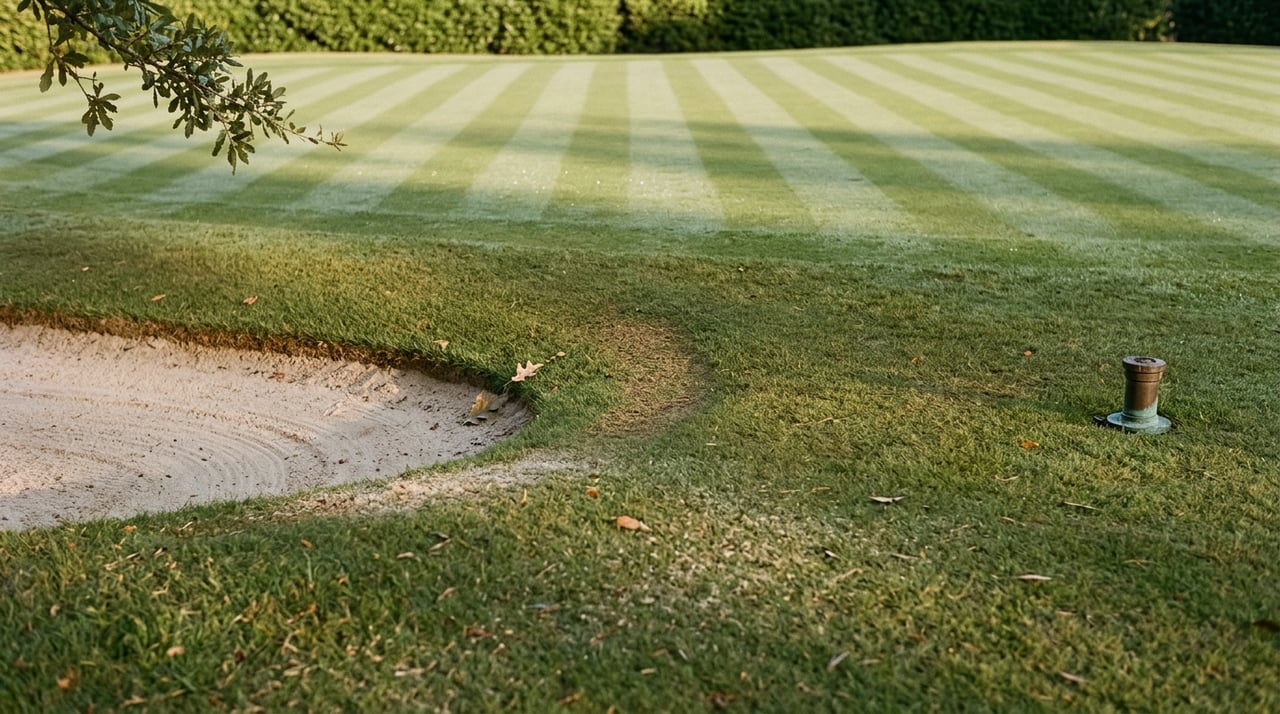
Walk the ninth green at Duck Woods Country Club this month and the ball does something it didn't do last July. It holds. A wedge shot lands, checks, and stays close to where it landed instead of skating through to the fringe. That's not a groundskeeper having a good week. It's what nine months of construction bought the club, and it's a better clue to what actually happened here than anything in the "grand reopening" press releases.
Duck Woods, the only full-service private country club on the Outer Banks, reopened its golf course on July 15 after what the club is calling the largest capital improvement project in its history. If the phrase "course renovation" has you picturing new length, a reshuffled routing, or a flashier layout, set that aside. What Duck Woods did was less dramatic to describe and more useful to actually play: it rebuilt what was failing underground and left the golf course itself alone.
Nine Months, Same Golf Course
The club's roots go back to the 1960s, when it started as the Outer Banks Recreation Association before its Ellis Maples-designed 18-hole course opened in 1969 and the property was renamed Duck Woods Country Club in 1988. That routing, on 300 acres of maritime forest in the middle of Southern Shores, is the same one members play today. Nothing about where the holes go or how they're sequenced changed this year.
What changed is what sits under the grass. Members approved a comprehensive rebuild of the greens, bunkers, and irrigation and drainage systems in January 2025. The club brought in golf architecture and construction firm CR Lutzke and financed the work through TowneBank. Construction started in October 2025 and ran through the winter and spring before the course reopened this summer, which means the club spent most of a shoulder season with fairways torn up and no golf revenue coming in from the one activity most members join for. That's a real bet on infrastructure over appearance, and it's the opposite of what a lot of course "renovations" turn out to be.
The Real Fix Was Underneath
Here's the detail that tells you what kind of project this was: the new greens are 20 to 25 percent larger than the ones they replaced. That's not about making the course prettier. Larger putting surfaces mean more usable pin placements, which means superintendents can rotate hole locations more aggressively through a season instead of running the same handful of spots into the ground by August. On a course pushing sixty years old, that's a maintenance problem finally getting solved rather than papered over.
The scale of the underground work is what makes this a nine-figure-feeling project rather than a routine touch-up. Crews moved more than 8,700 tons of gravel and specialized greens mix, laid over two miles of new drainage pipe, and brought in 28 tractor-trailer loads of sod. General manager Tony Mobasser put it plainly when the course reopened: "The result is a course that honors the original design while positioning Duck Woods for the future." That's the whole project in one sentence. Keep the bones, replace the plumbing.
For members teeing off this fall, the practical differences show up in a few specific ways:
- More hole locations in rotation, since the enlarged greens give the grounds crew room to move pins without crowding worn turf
- Rebuilt bunkers with fresh sand and edging, replacing years of erosion and inconsistent lies
- Regraded drainage that should mean fewer soggy fairways and faster returns to play after the kind of afternoon thunderstorm that's routine on the Outer Banks in summer
None of that shows up in a scorecard. All of it shows up in how the course actually plays day to day, which is the part a golfer notices long after the ribbon-cutting is forgotten.
Why This Matters More Here Than It Would Elsewhere
A golf course renovation is a nice story in most towns. In Southern Shores, it carries a little more weight, because of how the town handles its beach.
Southern Shores has no free, walk-up public beach access the way some of its neighbors do. Parking at the town's beach accesses requires a permit issued to property owners, and the two largest access points, on Hillcrest Drive and Chicahauk Trail, sit behind permits from the Southern Shores Civic Association or the Chicahauk Property Owners Association rather than the town itself. It's a quieter, more residential model than the public beach parks you'll find a few miles south, and it's part of why Southern Shores reads as calmer and more wooded than the towns around it.
That model puts more weight on private, membership-based recreation to fill the role a public park or boardwalk would play elsewhere. Duck Woods is the biggest piece of that puzzle. It's the one place in town where golf, tennis, pickleball, swimming, and dining all happen on the same 300 acres, and it's why the state of that golf course matters to more households in Southern Shores than the membership roster alone would suggest.
More Than A Golf Story
The course gets the headline, but Duck Woods runs on more than its fairways. The club fields four Har-Tru clay tennis courts and two lighted Har-Tru clay pickleball courts, along with a bocce setup, a pool, and a fitness center. This spring's "Get Pickled" mixer pulled 35 players out for an afternoon on those pickleball courts, the kind of recurring social event that turns a membership into a routine rather than a line item.
Dining follows the same logic of options over formality. Members can eat in the casual Bistro, the more formal member dining room, out on the screened porch, or by the fire pit, with a snack bar near the golf shop for anyone making the turn. The club's "Un-Corked" series pairs themed dinners with matched drinks through the year, and the property has also hosted community events with a broader reach, including Couture by the Shore, an annual luncheon and fashion show benefiting the Outer Banks Relief Foundation, held there in May with TowneBank, the same bank that financed the golf course rebuild, as presenting sponsor. It's a small thread, but it says something about how tightly the club is woven into the town's civic calendar, not just its golf calendar.
The course was voted Best of OBX for 2026 even before the new greens opened, which says something about how well the old ones had aged. What members get now is a golf course that finally matches the rest of the club's reputation, and a fall season where the biggest talking point on the first tee won't be a new hazard or a redesigned hole. It'll be how much better the ball behaves once it lands.
If you're weighing what life actually looks like in a town like Southern Shores, beyond the market reports and school district maps, this is the kind of detail that tells you more than a listing sheet ever could. For a closer look at the neighborhood, or to talk through what living here day to day is really like, reach out to The Gamiel Team.